Showing posts with label Comments & Quotes & Cetera. Show all posts

Saturday, 25 July 2026


" A wound gives off its own light

surgeons say. 

If all the lamps in the house were turned out

you could dress this wound

by what shines from it. 


... Fairest reader I offer merely an analogy. "


Notes: Anne Carson's verses above are drawn from The Beauty of the Husband. The photograph is mine, taken en route ( June, 2026 )

Thursday, 25 December 2025


Enter


...the season for kindling the fire of hospitality in the hall, the genial flame of charity in the heart:


Christmas! 


Wednesday, 25 December 2024


Christmas is here...


Bringing good cheer


Enjoy!


Note: That is a Christmas Card ( 1966 ) by Joan Miró

Sunday, 17 March 2024


Happiness is 


 ...simply a temporary condition 

that proceeds unhappiness. 

Fortunately for us, it works the other way around 

as well. But it's all a part of the carnival, 

isn't it?”


Federico Fellini


Note: The picture above is a Self-Portrait of Giorgio de Chirico in Costume ( c.1948 )

Thursday, 24 August 2023


Trees & the Law 


"Trees are sanctuaries. Whoever knows 

how to speak to them, whoever knows 

how to listen to them, can learn the truth. 

They do not preach learning and precepts, 

they preach, undeterred by particulars, 

the ancient law of life."


· Herman Hesse ·


Note: The first painting, probably an aquarelle, is untitled and made by Philippos Gheskos, the son of Konstantinos Gheskos, the most prominent painter of my home town, Volos, and one of the acclaimed artists of the country. He, the latter, made the second painting featured above, titled "Landscape".

Thursday, 9 February 2023


The Greek language 


“...for me is a cosmogony. It is not just a language.” 


Luis José Navarro 


Today marks the International Greek Language Day – a celebration of the language which is spoken uninterruptedly for the last 40 centuries, using the same alphabet for the last 28 centuries and having the same spelling for the last 24 centuries. 

It was the Greeks of Italy who were the first to propose an international day for the Greek language – to celebrate the vital, fundamental role played by the Greek language in the shaping of Western civilization throughout the centuries.

One of the oldest languages in the world, the Greek language is the fundamental language, in scientific terms and usage, of Western science; esp. astronomy, mathematics, logic and philosophy. Countless Greek words enrich other languages, culminating in the international medical terminology in which about 80 percent of the scientific terms have a Greek root.

As for the ancient Greek literature – the epic poems (the Iliad and the Odyssey), the Platonic dialogues, the works of Aristotle, to name a few. The New Testament of the Christian Bible was also written in Koine (> common) Greek. The study of the ancient Greek writings and society, along with the ancient Latin texts and traditions from the Roman world is what constitutes the discipline of Classics; the classical Western canon. 

The Greek government eventually adopted the proposal – in 2OO7 the plenary session of the Greek parliament unanimously accepted it as an official institution. They selected the 9th February because it is also the official commemoration day of the Greek national poet Dionysios Solomos – the first to systematically cultivate the vernacular version of the Greek language (replacing the archaic-like form of Modern Greek that was used at the time) and thus paved the way for its use in literature .

However, it is not solely an academic or literary language. It is a contemporary colloquial one, too. And not only in Greece, by the Greeks. Don't be surprised if I tell you that you –whoever you are, wherever you are–, speak Greek but you don't know it. Check these words out: academy, air, anatomy, athlete, base, centre, chair, character, chorus, church, cinema, climate, comedy, cosmos, cycle, decade, democracy, dialogue, diet, disc. 

What is their translation in your, if not English, language?

Can you find some more?


Notes: Luis José Navarro is a professor of the Greek language and classical philologist. / The photograph captures the pages of the greek edition of "A Child of Books" by both the Irish writer and illustrator Oliver Jeffers and London-based visual artist Sam Wilson

Tuesday, 7 February 2023


Happening Now 


Small, red, and upright he waited,

gripping his new bookbag tight

in one hand and touching a lucky penny inside his coat pocket with the other,

while the first snows of winter

floated down on his eyelashes and covered the branches around him and silenced

all trace of the world.” 


· Anne Carson ·


*


Monday, 26 December 2022


Some

Special

Pieces


The Italians have panetone, the Germans stollen, the French both berawecka (pompe à huile) and the coquille de Noël, and the English the Christmas pudding – all sweet doughs with fillings of many fruits (glazed, candied or dried) diced. We, in Greece, have something quite different – a bread with a very distinctive taste, neither sweet nor savoury. The late Evi Voutsina, an acclaimed food reporter, cook and gourmand herself who wrote for Gastronomos magazine, loved it for its multi-layered texture of deliciousness, the robust taste of sourdough and the Christmas symbolism of its ingredients – warmth, mental power, well-being, rejuvenation.

So, this Christmas have some slices of the sourdough walnut bread especially for "...our loved ones, for all those who work, for the homeless of the world, for the soldiers who fight..."


Merry Christmas, everyone! 


Note: The blueish sentence in italics is bits and pieces drawn from the "Valse de Noel" or "A Waltz for Christmas" – the book (a joyful song, actually) Boris Vian wrote in 1955 for children and which, Natalie Choux , artist of many media, illustrated in 2O17.

Sunday, 4 September 2022


The Painter


Sitting between the sea and the buildings

He enjoyed painting the sea’s portrait.

But just as children imagine a prayer

Is merely silence, he expected his subject

To rush up the sand, and, seizing a brush,

Plaster its own portrait on the canvas.


So there was never any paint on his canvas

Until the people who lived in the buildings

Put him to work: “Try using the brush

As a means to an end. Select, for a portrait,

Something less angry and large, and more subject

To a painter’s moods, or, perhaps, to a prayer.”


How could he explain to them his prayer

That nature, not art, might usurp the canvas?

He chose his wife for a new subject,

Making her vast, like ruined buildings,

As if, forgetting itself, the portrait

Had expressed itself without a brush.


Slightly encouraged, he dipped his brush

In the sea, murmuring a heartfelt prayer:

“My soul, when I paint this next portrait

Let it be you who wrecks the canvas.”

The news spread like wildfire through the buildings:

He had gone back to the sea for his subject.


Imagine a painter crucified by his subject!

Too exhausted even to lift his brush,

He provoked some artists leaning from the buildings

To malicious mirth: “We haven’t a prayer

Now, of putting ourselves on canvas,

Or getting the sea to sit for a portrait!”


Others declared it a self-portrait.

Finally all indications of a subject

Began to fade, leaving the canvas

Perfectly white. He put down the brush.

At once a howl, that was also a prayer,

Arose from the overcrowded buildings.


They tossed him, the portrait, from the tallest of the buildings;

And the sea devoured the canvas and the brush

As though his subject had decided to remain a prayer.


 John Ashbery 


Note: The painting above is the "Grand Illusion" by a contemporary greek painter, Juliano Kaglis /  “The Painter” is drawn from "The Mooring of Starting Out: The First Five Books of Poetry" (Ecco Press, 1997)

Friday, 12 August 2022


"It's true, I do love music,"


he said. In his rare moments of leisure, Jean-Jacques Sempé indulges his love of music. He once said that his 1979 collection, The Musicians – exceptional in the Sempé oeuvre for its unambiguous reverence, its tenderness uninflected by irony – was his favourite of all his books.  He says: "I did once want to become a musician, but when I saw how professional musicians lived, I decided to go on drawing. I also thought it might be interesting to become an editor, or to work in the theatre..." A smile flickers across his face; the Great Wit rallies. "My real dream was to be centre forward on the French football team, but I had to put those ambitions to rest last year. I realised that there was a conspiracy against me, and so now I draw." He shrugs. "Their loss."

Our loss, today, M.
Sempé. Adieu.


Note: The sketch is drawn from Sempé's The Musicians. His words is an extract drawn from this article.

Monday, 7 March 2022


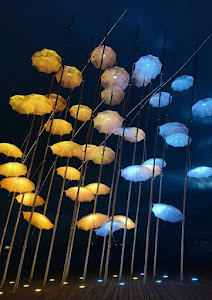
"It is the original idea...


that is unique, not the object itself. "


Victor Vasarely


Note: The "Umbrellas" is a signature artwork by George Zongolopoulos – a significant Greek sculptor, painter and architect. It is placed in Thessaloniki's new promenade, outside Macedonian Museum of Contemporary Art and this year, to show solidarity  and express sympathy to the Ukrainian people, the installation is  imbued with yellow and blue lights. It also turns out to be celebrating Ash Monday – the umbrellas resemble kites, in a still orbit though.

Sunday, 21 March 2021


Nothing Special


nothing special

boards paint

nails paste

paper string


mr artist

builds a world

not from atoms

but from remnants


forest of arden

from umbrella

ionian sea

from parkers quink


just as long as

his look is wise

just as long as

his hand is sure -


and presto the world -


hooks of flowers

on needles of grass

clouds of wire

drawn out by the wind


·


Zbigniew Herbert


Note: The artwork is a Study for the Head of "Poetry" (1895 - 1899) for the composition "The Apotheosis of Bavaria" by Nikolaos Gyzis. 

Friday, 25 December 2020

Friday, 29 May 2020


Not the first time


...for the case of George Floyd. There have been plenty of identically similar ones in the past. That of 22 year-old Oscar Grant has been turned into a biographical drama film in 2013. It was the feature directorial debut of Ryan Coogler and it won many awards – two of them in Sundance Film Festival (Grand Jury Prize and the Audience Award for U.S. dramatic film) and one in Cannes (Best First Film). 

Art awakens, they say. It does, indeed – the film  got praises, opened up discussions and caused controversies about the limits of dramatisation and the accuracy of the real event, was among the top ten lists for the best films of that year. This is the furthest the awakening got.  It did not change any attitudes, regulations or laws, nor did it bring this tragic and painful history to a halt as not to repeat itself. 

Oh well? 

This needs to be the last one. 


Note: You can read about the case od Oscar Grant here. // The New York Times follows the case of George Floyd closely. The latest update says that the former Minneapolis police officer seen on video using his knee to pin down George Floyd has been taken into custody and charged with third-degree murder while the investigation of three other officers at the scene of the incident is ongoing. You can watch the Live Updates here

Monday, 18 May 2020


 Today 


...is one of those memo days. It was established in 1977 when the International Council of Museums (ICOM) designated the 18th May as the International Museum Day aimining thus to highlight the role of museums in modern society and encourage us to visit them more often.

"Museums are managers of consciousness. They give us an interpretation of history, of how to view the world and locate ourselves in it. They are, if you want to put it in positive terms, great educational institutions." says artist and art critic Hans Haacke. You can see it for yourself with a visit, although one is never enough, I assure you. Beware: from the 15th June onwards, though, when the last restrictive measures will be lifted, according to the schedule of the Greek Ministry of Culture, and following all the necessary requirements for personal hygiene and safety - do not let yourselves be carried away.


Notes: The cartoon is by the acclaimed French Jean-Jacques Sempé, the co-creator (along with René Goscinny) of  Le petit Nicolas (here is an extensive list of the book series in Greek). // Due to the special COVID-19 restrictions, many Greek museums have organised and are conducting several online activities you can participate. More information here

Saturday, 18 April 2020


Greetings


for


Happy Easter!


Note: The artwork is the "Blue and Yellow Butterfly" by Alexander Calder

Sunday, 5 April 2020


Seeing things differently


"Most Holy Father, there are many who, on bringing their feeble judgment to bear on what is written concerning the great achievements of the Romans —the feats of arms, the city of Rome and the wondrous skill shown in the opulence, ornamentation and grandeur of their buildings— have come to the conclusion that these achievements are more likely to be fables than facts. I, however, have always seen —and still do see— things differently." Raffaello Sanzio da Urbino, known as Raphael, wrote in his letter to pope Leo X

His work is admired for its clarity of form, ease of composition, and visual achievement of the Neoplatonic ideal of human grandeur. Together with Michelangelo and Leonardo da Vinci, he forms the traditional trinity of great masters of that period.  He was extremely influential in his lifetime, though outside Rome his work was mostly known from his collaborative printmaking.  

The exquisite depiction of the Virgin and Child above is drawn in silverpoint – a technique which uses small rods of pure silver to make marks with an iridescent sheen. It’s one of a series made by the artist after he moved to Rome in 1508 to complete a fresco in the Pope’s private library in the Vatican – he was only 25 at the time. 


Notes: The drawing and the relevant information is taken from The British Museum. //  The National Gallery of Art in Washington, to honour his 500th anniversary of the death of Raphael, has launched  a 360 virtual tour of the exhibition "Raphael and His Circle" which allows you to read wall texts, listen to the audio tour, watch related video clips and learn more about the artist's drawings and the influence he had in his lifetime, and after his death. You can exlpore the full tour here

Wednesday, 25 March 2020


The Child


The Turks have been here. All is bleak, in ruin.
Chios, isle of wines, is now a darkened reef.

      Chios, cradled by green branches,
Chios, where curling waves mirror soft hills,
forests, palaces, and, on certain nights,

      dancing choirs of young girls,

All is desert. But no, near a blackened wall
sits a Greek child, a blue-eyed boy,

      alone and bending his head in shame.
For safety, for support, he has but a
single wrecked hawthorn bush, forgotten like him in

      this forgotten, wasted corner.

Oh poor child, barefoot on these sharp-edged rocks!
Oh to stop the crying of your blue eyes,

      blue like the sky and like the sea,
so that in their shine the light of laughter
and joy might evaporate this storm of tears;

      young boy, to lift up your blond head,

what would you wish for, oh beautiful boy,
what will it take to smile, to gather up

      in curls resting on your pale shoulder
this mop of hair never touched or shorn, which
seems to weep about your beautiful face

      like the leaves of the willow?

What will make your cloudy cares disappear?
Perhaps to have this lily from the fields

      of Iran, bright blue like your eyes?
Or some fruit from the magic Tuba-tree,
that tree so great that galloping horses

      run a century in its shadow?

Would you smile for a handsome forest bird
that sings more sweetly than flutes or oboes

      and more brilliantly than cymbals?
What would you like? Flowers, fruits, marvelous birds?
Friend, replies the Greek child with the clear blue eyes,

      I want some bullets and a gun.


~~ 


L’enfant

Les Turcs ont passé là. Tout est ruine et deuil.
Chio, l’île des vins, n’est plus qu’un sombre écueil,

      Chio, qu’ombrageaient les charmilles,
Chio, qui dans les flots reflétait ses grands bois,
Ses coteaux, ses palais, et le soir quelquefois

      Un chœur dansant de jeunes filles.

Tout est désert. Mais non ; seul près des murs noircis,
Un enfant aux yeux bleus, un enfant grec, assis,

      Courbait sa tête humiliée ;
Il avait pour asile, il avait pour appui
Une blanche aubépine, une fleur, comme lui

      Dans le grand ravage oubliée.

Ah ! pauvre enfant, pieds nus sur les rocs anguleux !
Hélas ! pour essuyer les pleurs de tes yeux bleus

      Comme le ciel et comme l’onde,
Pour que dans leur azur, de larmes orageux,
Passe le vif éclair de la joie et des jeux,

      Pour relever ta tête blonde,

Que veux-tu ? Bel enfant, que te faut-il donner
Pour rattacher gaîment et gaîment ramener

      En boucles sur ta blanche épaule
Ces cheveux, qui du fer n’ont pas subi l’affront,
Et qui pleurent épars autour de ton beau front,

      Comme les feuilles sur le saule ?

Qui pourrait dissiper tes chagrins nébuleux ?
Est-ce d’avoir ce lys, bleu comme tes yeux bleus,

      Qui d’Iran borde le puits sombre ?
Ou le fruit du tuba, de cet arbre si grand,
Qu’un cheval au galop met, toujours en courant,

      Cent ans à sortir de son ombre ?

Veux-tu, pour me sourire, un bel oiseau des bois,
Qui chante avec un chant plus doux que le hautbois,

      Plus éclatant que les cymbales ?
Que veux-tu ? fleur, beau fruit, ou l’oiseau merveilleux ?
– Ami, dit l’enfant grec, dit l’enfant aux yeux bleus,

      Je veux de la poudre et des balles.


Notes: The poem above is by Victor Hugo  translated in English by Gilles-Claude ThériaultThe detail is from the oil painting "The Greek boy" (1829/30 – Benaki Museum) by Alexandre Marie Colin who was inspired, for this painting, by Hugo's poem.