Her name
Her name
The Painter
Sitting between the sea and the buildings
He enjoyed painting the sea’s portrait.
But just as children imagine a prayer
Is merely silence, he expected his subject
To rush up the sand, and, seizing a brush,
Plaster its own portrait on the canvas.
So there was never any paint on his canvas
Until the people who lived in the buildings
Put him to work: “Try using the brush
As a means to an end. Select, for a portrait,
Something less angry and large, and more subject
To a painter’s moods, or, perhaps, to a prayer.”
How could he explain to them his prayer
That nature, not art, might usurp the canvas?
He chose his wife for a new subject,
Making her vast, like ruined buildings,
As if, forgetting itself, the portrait
Had expressed itself without a brush.
Slightly encouraged, he dipped his brush
In the sea, murmuring a heartfelt prayer:
“My soul, when I paint this next portrait
Let it be you who wrecks the canvas.”
The news spread like wildfire through the buildings:
He had gone back to the sea for his subject.
Imagine a painter crucified by his subject!
Too exhausted even to lift his brush,
He provoked some artists leaning from the buildings
To malicious mirth: “We haven’t a prayer
Now, of putting ourselves on canvas,
Or getting the sea to sit for a portrait!”
Others declared it a self-portrait.
Finally all indications of a subject
Began to fade, leaving the canvas
Perfectly white. He put down the brush.
At once a howl, that was also a prayer,
Arose from the overcrowded buildings.
They tossed him, the portrait, from the tallest of the buildings;
And the sea devoured the canvas and the brush
As though his subject had decided to remain a prayer.
Note: The painting above is the "Grand Illusion" by a contemporary greek painter, Juliano Kaglis / “The Painter” is drawn from "The Mooring of Starting Out: The First Five Books of Poetry" (Ecco Press, 1997)
"It's true, I do love music,"
he said. In his rare moments of leisure, Jean-Jacques Sempé indulges his love of music. He once said that his 1979 collection, The Musicians – exceptional in the Sempé oeuvre for its unambiguous reverence, its tenderness uninflected by irony – was his favourite of all his books. He says: "I did once want to become a musician, but when I saw how professional musicians lived, I decided to go on drawing. I also thought it might be interesting to become an editor, or to work in the theatre..." A smile flickers across his face; the Great Wit rallies. "My real dream was to be centre forward on the French football team, but I had to put those ambitions to rest last year. I realised that there was a conspiracy against me, and so now I draw." He shrugs. "Their loss."
Our loss, today, M. Sempé. Adieu.
Note: The sketch is drawn from Sempé's The Musicians. His words is an extract drawn from this article.
A journey up there,
in the sky
I wonder if the moon
over Kyiv
is as beautiful
as the moon over Rome,
I wonder if it’s the same moon
or merely her sister…
“Of course I’m the same!”
-the moon exclaims-
“Not some nightcap
for your head only!
As I journey up here,
I make light for all,
from India to Peru,
from the Tiber to the Dead Sea,
and my beams travel
without a passport.”
(translated from the Italian by Virginia Jewiss)
First published in 1955, the Moon Over Kyiv, the tender poem above, by the acclaimed italian children's author and journalist Gianni Rodari is published again. This time due to an initiative by publisher Einaudi Ragazzi and Beatrice Allemagna. "It was an awesome honor that they considered me" the italian illustrator and children's writer says. Maybe it was as a result of them having seen her very impressed by what is going on, in addition to knowing her love for Rodari, whose books she has already illustrated. "For me he is a non secular father, there’s always a slightly little bit of him in my works" she says.
In the form of an e-book, or a conventional paper one, it will be out almost simultaneously in many countries worldwide. "I discovered that kids’s books are a social and political act (...) I do not suppose there is a rise in manufacturing (books coping with warfare). I simply suppose they’re extra noticeable as a result of being within the highlight right now", she adds.
In Greece, where I live, "Το Φεγγάρι του Κιέβου" (translated by Antonis Papatheodoulou) is just published by Papadopoulos Books and the proceedings from the sales will be donated to Médecins Sans Frontières / Doctors without Borders, thus supporting their work in Ukraine (take a look here).
that is unique, not the object itself. "
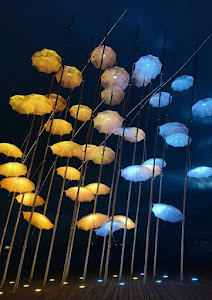
Note: The "Umbrellas" is a signature artwork by George Zongolopoulos – a significant Greek sculptor, painter and architect. It is placed in Thessaloniki's new promenade, outside Macedonian Museum of Contemporary Art and this year, to show solidarity and express sympathy to the Ukrainian people, the installation is imbued with yellow and blue lights. It also turns out to be celebrating Ash Monday – the umbrellas resemble kites, in a still orbit though.
A Word On Statistics
those who always know better:
fifty-two.
Unsure of every step:
almost all the rest.
Ready to help,
if it doesn't take long:
forty-nine.
Always good,
because they cannot be otherwise:
four, well maybe five.
Able to admire without envy:
eighteen.
Led to error
by youth (which passes):
sixty, plus or minus.
Those not to be messed with:
four-and-forty.
Living in constant fear
of someone or something:
seventy-seven.
Capable of happiness:
twenty-some-odd at most.
Harmless alone,
turning savage in crowds:
more than half, for sure.
Cruel
when forced by circumstances:
it's better not to know,
not even approximately.
Wise in hindsight:
not many more
than wise in foresight.
Getting nothing out of life except things:
thirty
(though I would like to be wrong).
Balled up in pain
and without a flashlight in the dark:
eighty-three, sooner or later.
Those who are just:
quite a few, thirty-five.
But if it takes effort to understand:
three.
Worthy of empathy:
ninety-nine.
Mortal:
one hundred out of one hundred
a figure that has never varied yet.”
Note: The "Luci di Nara" or "The light of moon" is a sculpture, characteristic of Igor Mitoraj's work. In the photo above, it is installed outside The British Museum (1991).