Saturday, 25 July 2026


" A wound gives off its own light

surgeons say. 

If all the lamps in the house were turned out

you could dress this wound

by what shines from it. 


... Fairest reader I offer merely an analogy. "


Notes: Anne Carson's verses above are drawn from The Beauty of the Husband. The photograph is mine, taken en route ( June, 2026 )

Thursday, 25 December 2025


Enter


...the season for kindling the fire of hospitality in the hall, the genial flame of charity in the heart:


Christmas! 


Wednesday, 25 December 2024


Christmas is here...


Bringing good cheer


Enjoy!


Note: That is a Christmas Card ( 1966 ) by Joan Miró

Sunday, 17 March 2024


Happiness is 


 ...simply a temporary condition 

that proceeds unhappiness. 

Fortunately for us, it works the other way around 

as well. But it's all a part of the carnival, 

isn't it?”


Federico Fellini


Note: The picture above is a Self-Portrait of Giorgio de Chirico in Costume ( c.1948 )

Thursday, 24 August 2023


Trees & the Law 


"Trees are sanctuaries. Whoever knows 

how to speak to them, whoever knows 

how to listen to them, can learn the truth. 

They do not preach learning and precepts, 

they preach, undeterred by particulars, 

the ancient law of life."


· Herman Hesse ·


Note: The first painting, probably an aquarelle, is untitled and made by Philippos Gheskos, the son of Konstantinos Gheskos, the most prominent painter of my home town, Volos, and one of the acclaimed artists of the country. He, the latter, made the second painting featured above, titled "Landscape".

Thursday, 9 February 2023


The Greek language 


“...for me is a cosmogony. It is not just a language.” 


Luis José Navarro 


Today marks the International Greek Language Day – a celebration of the language which is spoken uninterruptedly for the last 40 centuries, using the same alphabet for the last 28 centuries and having the same spelling for the last 24 centuries. 

It was the Greeks of Italy who were the first to propose an international day for the Greek language – to celebrate the vital, fundamental role played by the Greek language in the shaping of Western civilization throughout the centuries.

One of the oldest languages in the world, the Greek language is the fundamental language, in scientific terms and usage, of Western science; esp. astronomy, mathematics, logic and philosophy. Countless Greek words enrich other languages, culminating in the international medical terminology in which about 80 percent of the scientific terms have a Greek root.

As for the ancient Greek literature – the epic poems (the Iliad and the Odyssey), the Platonic dialogues, the works of Aristotle, to name a few. The New Testament of the Christian Bible was also written in Koine (> common) Greek. The study of the ancient Greek writings and society, along with the ancient Latin texts and traditions from the Roman world is what constitutes the discipline of Classics; the classical Western canon. 

The Greek government eventually adopted the proposal – in 2OO7 the plenary session of the Greek parliament unanimously accepted it as an official institution. They selected the 9th February because it is also the official commemoration day of the Greek national poet Dionysios Solomos – the first to systematically cultivate the vernacular version of the Greek language (replacing the archaic-like form of Modern Greek that was used at the time) and thus paved the way for its use in literature .

However, it is not solely an academic or literary language. It is a contemporary colloquial one, too. And not only in Greece, by the Greeks. Don't be surprised if I tell you that you –whoever you are, wherever you are–, speak Greek but you don't know it. Check these words out: academy, air, anatomy, athlete, base, centre, chair, character, chorus, church, cinema, climate, comedy, cosmos, cycle, decade, democracy, dialogue, diet, disc. 

What is their translation in your, if not English, language?

Can you find some more?


Notes: Luis José Navarro is a professor of the Greek language and classical philologist. / The photograph captures the pages of the greek edition of "A Child of Books" by both the Irish writer and illustrator Oliver Jeffers and London-based visual artist Sam Wilson

Tuesday, 7 February 2023


Happening Now 


Small, red, and upright he waited,

gripping his new bookbag tight

in one hand and touching a lucky penny inside his coat pocket with the other,

while the first snows of winter

floated down on his eyelashes and covered the branches around him and silenced

all trace of the world.” 


· Anne Carson ·


*


Monday, 26 December 2022


Some

Special

Pieces


The Italians have panetone, the Germans stollen, the French both berawecka (pompe à huile) and the coquille de Noël, and the English the Christmas pudding – all sweet doughs with fillings of many fruits (glazed, candied or dried) diced. We, in Greece, have something quite different – a bread with a very distinctive taste, neither sweet nor savoury. The late Evi Voutsina, an acclaimed food reporter, cook and gourmand herself who wrote for Gastronomos magazine, loved it for its multi-layered texture of deliciousness, the robust taste of sourdough and the Christmas symbolism of its ingredients – warmth, mental power, well-being, rejuvenation.

So, this Christmas have some slices of the sourdough walnut bread especially for "...our loved ones, for all those who work, for the homeless of the world, for the soldiers who fight..."


Merry Christmas, everyone! 


Note: The blueish sentence in italics is bits and pieces drawn from the "Valse de Noel" or "A Waltz for Christmas" – the book (a joyful song, actually) Boris Vian wrote in 1955 for children and which, Natalie Choux , artist of many media, illustrated in 2O17.

Wednesday, 12 October 2022


Her name


...did not come as a surprise. Annie Ernaux, writer and professor of literature, was among the Top 5 writers to get the  2022 Nobel Prize in Literature, according to the bookies' odds. On 6th October, she finally did. For "...the courage and clinical acuity with which she uncovers the roots, estrangements and collective restraints of personal memory."

This is  a, nonetheless, non-comformist choice as the ones the Swedish Academy prefers – the way Ernaux reconstructs the past is extraordinary not only in its use of language but also, in the way her works link to sociology and its pioneering genre that was beyond its time.  It is also a wide nod to the world, a nod in favour of women and their right to their bodies – first, USAwards and then towards Iran. As a symbolism, this prize aims against obscurantism and all sorts of authoritarianism –of both individual attitudes and regimes–, in an insightful manner.  

A very dynamic choice, indeed. A key hint to designate the reality of current affairs. If you haven't read any of her books yet, please do – they're worth every minute of your time.


Notes: Two years ago, I wrote about her book "A man's place". / You can watch the committee announcement here. The portrait of the French laureate is by Niklas Elmehed the official artist for the Swedish Academy Laureates Portraits.

Sunday, 4 September 2022


The Painter


Sitting between the sea and the buildings

He enjoyed painting the sea’s portrait.

But just as children imagine a prayer

Is merely silence, he expected his subject

To rush up the sand, and, seizing a brush,

Plaster its own portrait on the canvas.


So there was never any paint on his canvas

Until the people who lived in the buildings

Put him to work: “Try using the brush

As a means to an end. Select, for a portrait,

Something less angry and large, and more subject

To a painter’s moods, or, perhaps, to a prayer.”


How could he explain to them his prayer

That nature, not art, might usurp the canvas?

He chose his wife for a new subject,

Making her vast, like ruined buildings,

As if, forgetting itself, the portrait

Had expressed itself without a brush.


Slightly encouraged, he dipped his brush

In the sea, murmuring a heartfelt prayer:

“My soul, when I paint this next portrait

Let it be you who wrecks the canvas.”

The news spread like wildfire through the buildings:

He had gone back to the sea for his subject.


Imagine a painter crucified by his subject!

Too exhausted even to lift his brush,

He provoked some artists leaning from the buildings

To malicious mirth: “We haven’t a prayer

Now, of putting ourselves on canvas,

Or getting the sea to sit for a portrait!”


Others declared it a self-portrait.

Finally all indications of a subject

Began to fade, leaving the canvas

Perfectly white. He put down the brush.

At once a howl, that was also a prayer,

Arose from the overcrowded buildings.


They tossed him, the portrait, from the tallest of the buildings;

And the sea devoured the canvas and the brush

As though his subject had decided to remain a prayer.


 John Ashbery 


Note: The painting above is the "Grand Illusion" by a contemporary greek painter, Juliano Kaglis /  “The Painter” is drawn from "The Mooring of Starting Out: The First Five Books of Poetry" (Ecco Press, 1997)

Friday, 12 August 2022


"It's true, I do love music,"


he said. In his rare moments of leisure, Jean-Jacques Sempé indulges his love of music. He once said that his 1979 collection, The Musicians – exceptional in the Sempé oeuvre for its unambiguous reverence, its tenderness uninflected by irony – was his favourite of all his books.  He says: "I did once want to become a musician, but when I saw how professional musicians lived, I decided to go on drawing. I also thought it might be interesting to become an editor, or to work in the theatre..." A smile flickers across his face; the Great Wit rallies. "My real dream was to be centre forward on the French football team, but I had to put those ambitions to rest last year. I realised that there was a conspiracy against me, and so now I draw." He shrugs. "Their loss."

Our loss, today, M.
Sempé. Adieu.


Note: The sketch is drawn from Sempé's The Musicians. His words is an extract drawn from this article.

Wednesday, 13 April 2022


A journey up there, 


in the sky


I wonder if the moon

over Kyiv

is as beautiful

as the moon over Rome,

I wonder if it’s the same moon

or merely her sister…


“Of course I’m the same!”

-the moon exclaims-

“Not some nightcap

for your head only!

As I journey up here,

I make light for all,

from India to Peru,

from the Tiber to the Dead Sea,

and my beams travel

without a passport.”


(translated from the Italian by Virginia Jewiss)


First published in 1955, the Moon Over Kyiv, the tender poem above,  by the acclaimed italian children's author and journalist Gianni Rodari  is published again. This time  due to an initiative by publisher Einaudi Ragazzi and Beatrice Allemagna"It was an awesome honor that they considered me" the italian illustrator and children's writer says. Maybe it was as a result of them having seen her very impressed by what is going on, in addition to knowing her love for Rodari, whose books she has already illustrated. "For me he is  a non secular father, there’s always a slightly little bit of him in my works" she says. 

In the form of an e-book, or a conventional paper one, it will be out almost simultaneously in many countries worldwide. "I discovered that kids’s books are a social and political act (...)  I do not suppose there is a rise in manufacturing (books coping with warfare). I simply suppose they’re extra noticeable as a result of being within the highlight right now", she adds.

In Greece, where I live, "Το Φεγγάρι του Κιέβου" (translated by Antonis Papatheodoulou) is just published by Papadopoulos Books and the proceedings from the sales will be donated to  Médecins Sans Frontières / Doctors without Borders, thus supporting their work in Ukraine (take a look here). 

Monday, 7 March 2022


"It is the original idea...


that is unique, not the object itself. "


Victor Vasarely


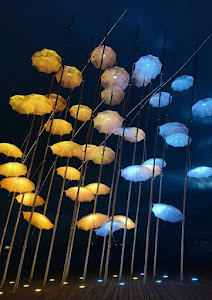
Note: The "Umbrellas" is a signature artwork by George Zongolopoulos – a significant Greek sculptor, painter and architect. It is placed in Thessaloniki's new promenade, outside Macedonian Museum of Contemporary Art and this year, to show solidarity  and express sympathy to the Ukrainian people, the installation is  imbued with yellow and blue lights. It also turns out to be celebrating Ash Monday – the umbrellas resemble kites, in a still orbit though.

Tuesday, 18 May 2021


A Word On Statistics


 Out of every hundred people,


those who always know better:

fifty-two.


Unsure of every step:

almost all the rest.


Ready to help,

if it doesn't take long:

forty-nine.


Always good,

because they cannot be otherwise:

four, well maybe five.


Able to admire without envy:

eighteen.


Led to error

by youth (which passes):

sixty, plus or minus.


Those not to be messed with:

four-and-forty.


Living in constant fear

of someone or something:

seventy-seven.


Capable of happiness:

twenty-some-odd at most.


Harmless alone,

turning savage in crowds:

more than half, for sure.


Cruel

when forced by circumstances:

it's better not to know,

not even approximately.


Wise in hindsight:

not many more

than wise in foresight.


Getting nothing out of life except things:

thirty

(though I would like to be wrong).


Balled up in pain

and without a flashlight in the dark:

eighty-three, sooner or later.


Those who are just:

quite a few, thirty-five.


But if it takes effort to understand:

three.


Worthy of empathy:

ninety-nine.


Mortal:

one hundred out of one hundred

a figure that has never varied yet.”


Wisława Szymborska


Note: The "Luci di Nara"  or "The light of moon" is a sculpture, characteristic of Igor Mitoraj's work. In the photo above, it is installed outside The British Museum (1991). 

Sunday, 16 May 2021


The Three Oddest Words


" When I pronounce the word Future,

the first syllable already belongs to the past.

When I pronounce the word Silence,

I destroy it.

When I pronounce the word nothing,

I make something no nonbeing can hold. "


Wisława Szymborska


Sunday, 21 March 2021


Nothing Special


nothing special

boards paint

nails paste

paper string


mr artist

builds a world

not from atoms

but from remnants


forest of arden

from umbrella

ionian sea

from parkers quink


just as long as

his look is wise

just as long as

his hand is sure -


and presto the world -


hooks of flowers

on needles of grass

clouds of wire

drawn out by the wind


·


Zbigniew Herbert


Note: The artwork is a Study for the Head of "Poetry" (1895 - 1899) for the composition "The Apotheosis of Bavaria" by Nikolaos Gyzis. 

Friday, 25 December 2020

Thursday, 8 October 2020


Ascending Figure


This year's Nobel Prize in Literature is awarded to an american poetess and essayist for "her unmistakable poetic voice that with austere beauty makes individual existence universal."

Louise Elisabeth Glück – one of the purest and most talented contemporary litterateurs in her field. She is distinguished for the linguistic and technical accuracy of her poetry, her sensitivity and insight  into matters of loneliness, family relationships, divorce and death. She is also noted for her "classicizing of gestures" - i.e. the frequent reworking of Greek and Roman myths in order to speak of destructive inter/personal relationships, existential despair and the agony of self. 

A poetess with an extensive body of work and many highly prestigious awards for it, Louise Glück is currently an adjunct professor and Rosenkranz Writer in Residence at Yale University. Once, she said: "Writing is a kind of revenge against circumstances: bad luck, loss, pain." It applies to reading, too. After a series of unconventional and controversial choices that seemed somehow superficial, the Swedish Academy are back on track with this timely and insightful selection for the current circumstances. 


Notes: You can read a random compilation of Louise Glück's poems here. / You can watch the Nobel Prize announcement here. / The portrait of the poetess is illustrated by Niklas Elmehed, the Swedish artist responsible for the official portraits of the Nobel Prize Laureates

Saturday, 3 October 2020


Atonement,

the French way


Sixteen years after her father's death, Annie Ernaux begins to write a novel about him. For some reason, "deciphering these memories is an urgent need for me..." she says. 

"A Man's Place" (translated by Tanya Lesley - Fitzcarraldo Editions, 2020) is shorter than a novel but it certainly has all the characteristic of the kind. The narration begins with the success of the French author in state exams for her appointment in public education. It goes on  with her father's death and in the next 94 pages the author describes many short events of his life - being the son of a sharecropper in Normandy, he started work as a cowboy and then in a factory. After getting married, he decides to open his own little store. So he becomes the owner of a grocery-coffee shop. Together with his wife, they work hard and despite the many adversities, at a time when the advent of supermarkets puts their business at serious risk, they manage to get out of poverty and sent their daughter to university. Always keeping her distance from her aging father, she studies, gets appointed to public education as a philologist, gets married and has a child who is just as distant - on a visit to her parents' home for the holidays, mother and son are walking past the room of the sick grandfather, when the little body asks the author: "Mommy, why is the gentleman beddy-bye?"


It could be a highly melodramatic novel, even a tragic one – a daughter's memories of her father is quite good material. Especially when this father was born, raised and manned in primitive conditions. However, Ernaux chooses to keep a record of her family's ethnology with meticulous accuracy and objectivity. This neutral style has established her as one of the most important contemporary writers in France and the greatest registrar of truth. "It's the writer's job to tell the truth," she said in an interview. "Sometimes I don't know what exactly it is, but the truth is what I'm looking for." 

I tried to discern the truth she is looking for in this book. It could just be the understanding of the ever winding maze of the father-daughter relationship, but that's not all. It is something deeper that oozes out - her father's inner strength and his (in fact, theirs - her parents') insistence on overcoming any hardships they came across and keep on progressing. And this, coming from people completely deprived of childhood and education, to say the least, is the definition of life. A life that you can rightly say has been worhtwhile - the exact point that makes the book contemporary.

There is, however, something even deeper that. I cannot identify it at once. I read the epigram on the front page again. It is a quotation by Jean Genet "May I venture an explanation: writing is the ultimate resource for those who have betrayed." And there lies her truth, the urgent need that led the author to "A Man's Place". It is the unacknowledged guilt about her own social development and, perhaps even more, the non-reactive, observational attitude she held towards her father as a child: "... I was repulsed, convinced  (by the memories of her living with her parents) of their  insignificance. And if they survived, it was only through humiliation. I gave in to the desire of the world I live in, of a world that forces you to forget the memories of a humble life as it is something that shows bad taste. "


"A Man's Place" was first published in 1983 (in France), causing sparking debates and criticism, but the following year won the Prix Renaudot. That was the beginning of many distinctions that followed for the author and the conquest of her personal style. With this distinctively still, emotionless way of writing, she composes here an eloquent portrait of her father and his time – no coincidence that she is also considered the most important chronicler of French society of the last 50 years. She even goes further than that: she extends her personal experience, as she did in "The Years", into universal matters – generation and class alienation, mourning for parents and their gradual erasure from memory. Even if it was generated by an unpleasant feeling, Annie Ernaux should be really proud of this portrait - an elegant, perfectly written narrative. Insightful, touching (against her efforts), memorable.


*


Notes: The photographes show the café épicerie of the author's parents and her father himself. They are drawn from "Quatro" (Gallimard, 2011). // The greek edition of the book was also published in 2020. You can read about it,  in Greek,  here. You can read about her novel "The Years", also in Greek, here